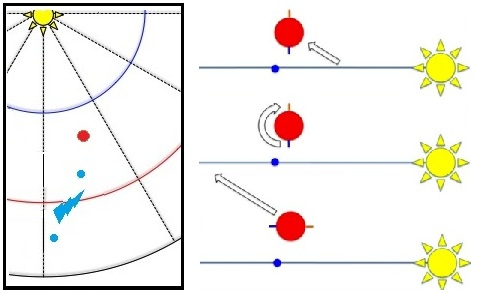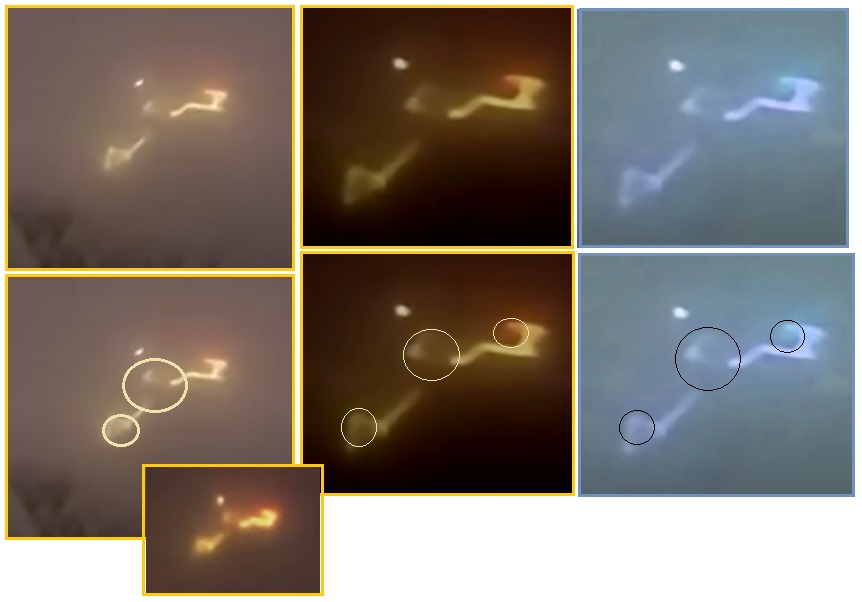
The following is a description of the Passage, as detailed in Newsletter
326 in 2012 and unchanged since that date. The Zeta
predictions have likewise remained unchanged. The date of
Passage is currently predicted to occur in February, 2027 with
the Last Weeks during the 7.3 weeks prior. At present, as we
have but months to go before the Passage, we are in the first
270 Roll and Nibiru is centered in front of the Sun. Taki has
labeled Nibiru as X, the Dark Twin as DT, the Earth as E, etc.
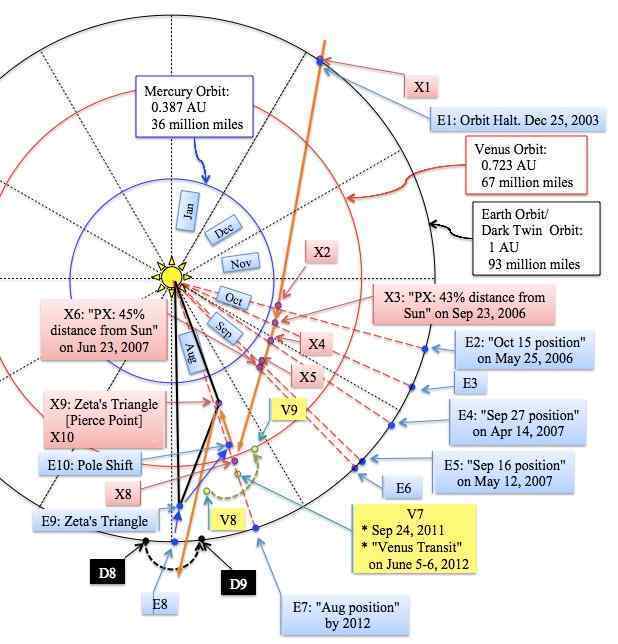
The path of Planet X through the inner solar system is complex,
mind boggling when put on the same diagram, so lets take this
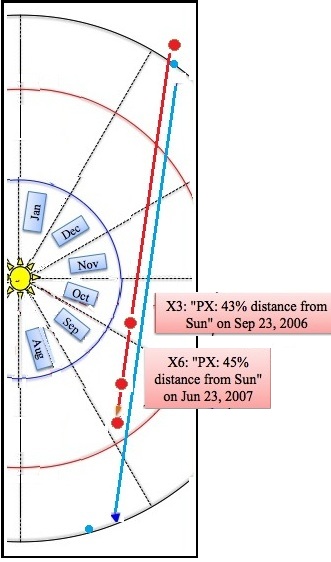
step-by-step. The location of Planet X has at times been given
as within the orbit of Venus or a certain distance from the Sun,
in miles or as a percentage. Here’s the frame of reference.
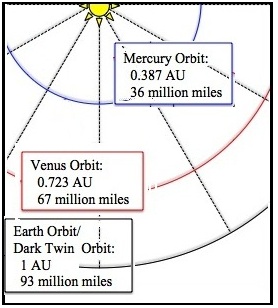
The path of Planet X has been described by the Zetas as moving
slowly past the Sun in a retrograde orbit. For the Earth, this
has been described as encountering Planet X in her path in 2003
and halting her orbit, being pushed back in her orbit to the
August position, and being tipped back and forth to simulate the
seasons.
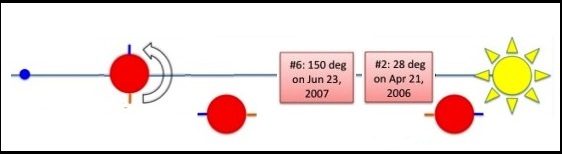
Meanwhile, Planet X at first noses its N Pole at the Sun’s S
Pole and then as it passes the Sun, swinging its N Pole outward
toward the Earth. This is a horizontal 180° turn to point the N
Pole toward the Earth, increasing the wobble. Progress in this
180° turn was confirmed to be 150° in June 2007, but the Zetas
have since withheld further confirmation. The Zetas stated the
roll must proceed to 195° in a horizontal turn before completing
the roll by standing upright for the last 90° into a
side-by-side arrangement predicted to occur during the Last
Weeks.
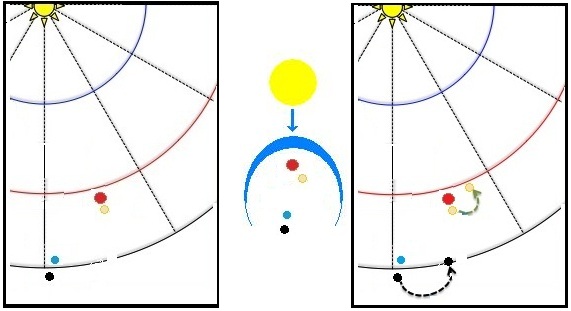
While Planet X is pushing the Earth back in her orbit, Venus and
the Dark Twin that shares Earth’s orbit have come around to
encounter the gravity presence of Planet X in their path, and
likewise halted in their orbits. All three planets are caught in
the eddy flow of particles coming round Planet X from the Sun.
As Planet X continues its outbound path, all are squeezed closer
together in the cup, and Venus and the Dark Twin loom large.
Then, during the Last Weeks, Venus and the Dark Twin escape the
cup.
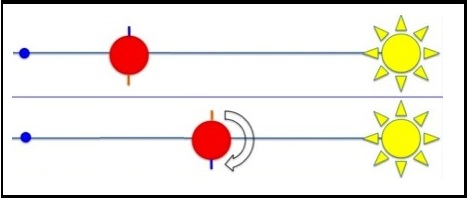
Planet X at this point has moved close enough to the Ecliptic,
the Sun’s middle, to find itself magnetically conflicted with
the Sun’s magnetic field above the Ecliptic. Planet X pierces
the Ecliptic and goes into the start of its second 270° roll. In
this it is drawn closer to the Sun by being in opposition,
allowing magnetons to flow from the N Pole of the Sun into the S
Pole of Planet X. Planet X jumps closer to the Sun, literally
pulled there.
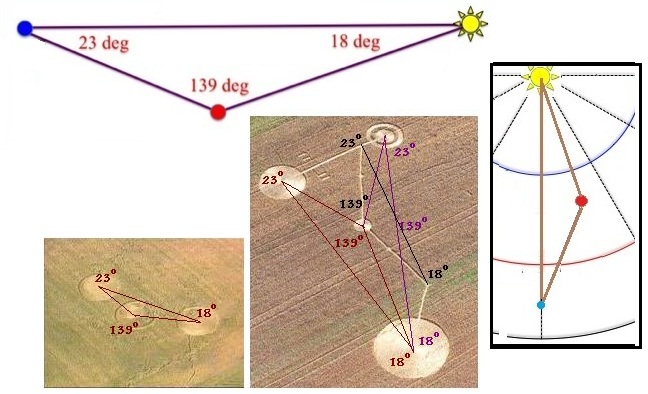
The ZetaTalk triangle is formed at this point. Planet X had
begun to pull the Earth closer to it when Venus and the Dark
Twin left the cup and both the Earth and Planet X were standing
upright, side-by-side. The angles in the famous ZetaTalk
Triangle, which appeared multiple times in a crop circle in
Nancy’s home state of Wisconsin in July, 2003, can only be
achieved when Planet X has jumped closer to the Sun and the
Earth has been drawn closer to Planet X.
Then during the last week, the week of rotation stoppage, the
Earth is drawn 30 million miles closer to Planet X, so the
Planet X complex appears huge in the skies. The two planets
remain at a distance of 14 million miles, however, with the
large moons in the Moon Swirls close to Planet X at all times,
within 5 million miles. Nevertheless, debris and red dust land
on the Earth during this time. Planet X begins its rapid exit
from the solar system, completing its second 270° roll. The N
Pole of Planet X grabs the Earth’s S Pole and pulls it up as it
does, causing a 90° crustal shift on Earth.